
A small file change caught Big Attention.
On October 9, 2025, China’s Ministry of Commerce (MOFCOM) issued Announcement No. 61 of 2025, introducing new export controls on overseas shipments of rare-earth related materials that contain Chinese-origin components. The regulation clearly states that exports for military purposes will, in principle, not be licensed.
While the policy content itself drew headlines, one detail surprised many observers:
The annex to the announcement was not a Microsoft Word (.doc/.docx) or PDF file.
It was released in .wps format — the proprietary file format of Kingsoft WPS Office, a Chinese-developed productivity suite.
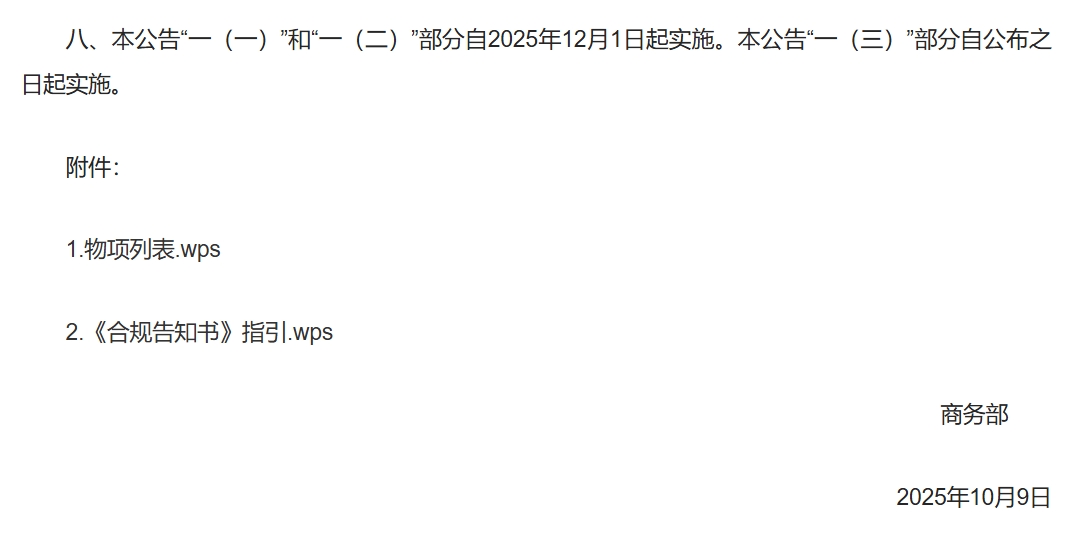
This is reportedly the first time MOFCOM has released an official document in this format. For a ministry whose documents are usually distributed in U.S.-standard formats, the change feels symbolic.
What Exactly Is WPS Format?
The WPS format is used by WPS Office, a full-featured office software suite developed by Kingsoft Corporation (金山办公软件), a Beijing-based company founded in 1989 and publicly listed in Shanghai. WPS Office includes WPS Writer, WPS Spreadsheets, and WPS Presentation, roughly equivalent to Microsoft Word, Excel, and PowerPoint.
Kingsoft was once a small competitor of Microsoft Office in the 1990s and early 2000s. But over time, WPS Office evolved into a cloud-integrated, cross-platform product available on Windows, macOS, Linux, Android, iOS, and the web.
According to publicly available data from Statista and Kingsoft’s 2022 annual report, WPS Office has:
- Over 494 million monthly active users worldwide
- More than 1.2 billion cumulative installations
- Deep integration into China’s government and enterprise systems, where it often replaces Microsoft Office for licensing and security reasons
From a usability standpoint, WPS Office supports almost all mainstream formats — including .docx, .xlsx, and .pdf — while maintaining its own .wps structure. For users in China, it’s lighter, cheaper, and more compatible with domestic cloud services.
Why the Switch Matters: Beyond File Types
MOFCOM’s adoption of WPS format is not just a technical decision — it’s a symbolic gesture of digital sovereignty. It reflects at least three broader messages:
Reducing reliance on U.S. software ecosystems
Microsoft Word and Adobe Acrobat (PDF) are both U.S. technologies. By publishing official documents in a domestic format, Chinese authorities signal a preference for homegrown software that’s not subject to U.S. export restrictions or licensing risks.Enhancing control and security
Using a Chinese-developed office suite helps ensure data residency, content security, and regulatory compliance under Chinese cybersecurity laws. Sensitive government documents stay within domestic systems, using software that can be fully audited.Promoting local technology adoption
When a key ministry like MOFCOM adopts WPS Office, other agencies and state-owned enterprises are likely to follow. This could accelerate broader government-wide migration toward domestic office platforms — a trend that Beijing has encouraged in recent years under the banner of “xinchuang” (信创, “IT application innovation”).
In short, the file format itself carries geopolitical meaning. It represents one more quiet but deliberate step in China’s ongoing effort to decouple from U.S.-dominated software infrastructure.
China’s Confidence in Decoupling
Such a move makes sense only if China has the capacity to sustain it — and, increasingly, it does.
- Industrial completeness: China is the only country with a full industrial chain across nearly all sectors, from raw materials to high-end manufacturing.
- Talent and education: With one of the world’s largest pools of STEM graduates and researchers, China’s scientific capacity keeps growing.
- Emerging domestic alternatives:
- DeepSeek — open-source AI language models developed by Chinese researchers
- Huawei Atlas 900 — one of the world’s fastest AI computing clusters
- HarmonyOS (Hongmeng) — a self-developed operating system running on hundreds of millions of devices
- Government policy support: Beijing continues to fund and promote domestic software and hardware ecosystems, ensuring strategic technologies can operate independently of foreign suppliers.
These strengths give China the confidence and capability to counter U.S. restrictions in semiconductors, AI, and software — and to push forward its localization agenda in every critical layer of technology.
Meanwhile, Microsoft Still Dominates Globally
Despite China’s progress, Microsoft Office (now part of Microsoft 365) remains the world’s dominant productivity suite. Its integration with AI Copilot, OneDrive, and Teams offers unmatched convenience for enterprise users. Microsoft’s ecosystem continues to expand across both business and education sectors worldwide.
For individuals or small teams, the Microsoft 365 Family subscription remains the most cost-effective option. A shared five-year plan (sometimes called a “group purchase” or “account sharing”) can save users up to $299 USD compared with individual annual renewals.
Final Thoughts
The fact that MOFCOM — China’s key trade and export-control authority — chose WPS format for an official regulatory document may seem minor. But symbolically, it’s another sign of a larger shift:
China’s determination to build digital independence, reduce reliance on U.S. technology, and strengthen confidence in its domestic software ecosystem.
In the era of global tech rivalry, even the choice of a file format can carry strategic weight.
Further Reading:
