
It’s July 2026. Spain just reported 327 heat-related deaths during a June that broke every temperature record on file — southern regions hit 45°C (113°F). France saw 43.8°C in the west. The UK just had its hottest June day in history. Europe is warming at twice the global average rate, and the WHO estimates heat kills 175,000 Europeans every year.
And yet only about 20% of European homes have air conditioning. The reason isn’t that Europeans inexplicably enjoy sweating through 40-degree nights. It’s that for 60% or more of European homes — many of which are century-old buildings — installing a traditional split-system air conditioner with an external condenser unit is either illegal, impossibly expensive, or both.
- In Paris, the entire city center is a protected historic zone. Mounting an external AC unit on a Haussmann building requires navigating strata votes and heritage authority approval — and most applications are rejected outright.
- In Spain, external walls are considered communal property. Installing a wall-mounted unit needs consent from at least 60% of owners in the building.
- Across the EU, fines for unauthorized exterior modifications can run into thousands of euros. In Spain, fines can reach €60,000 for historic building violations.
You need to cool down. The law says you can’t drill into the facade.
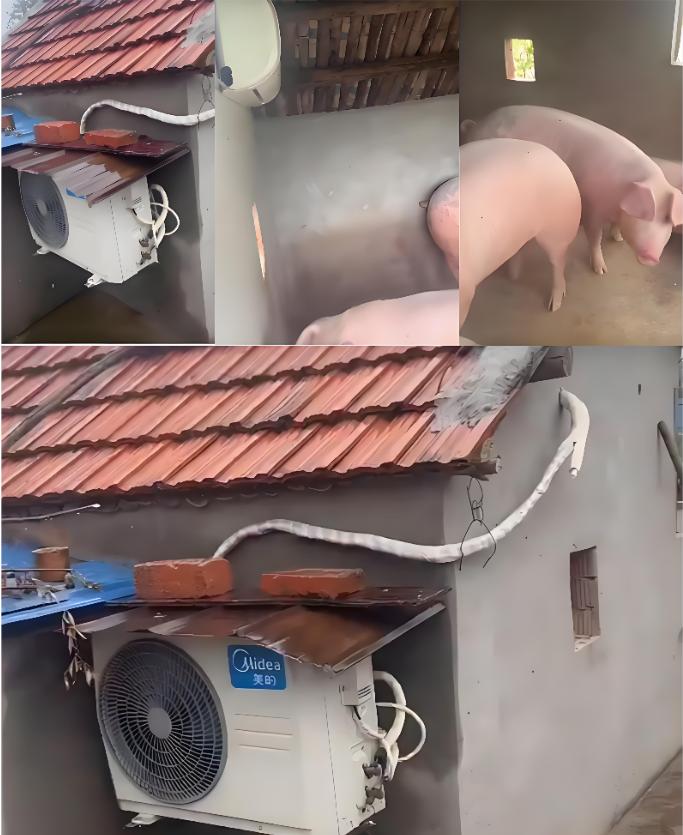
Compare this to China, where air conditioning is so ubiquitous that even pig farms install AC units to keep livestock cool during heat waves. Yes, pigs get air conditioning. Meanwhile, a Parisian family in a top-floor apartment — the hottest floor in any building, and the one where heat deaths concentrate — cannot legally install a standard AC. The contrast is hard to ignore.
Fortunately, Europe’s AC market has evolved rapidly in the last two years. New form factors — mobile split systems, no-external-unit designs, and inverter-powered window units — now offer real alternatives that comply with EU regulations and don’t require drilling into historic facades. And they’re available directly from European Amazon sites with native 220-240V power, so you don’t have to mess with voltage converters or import US models.
European Regulations: What to Look For
If you’re buying an AC for use in Europe, here’s what matters.
1. EU Energy Label: Don’t Buy Anything Below A
Air conditioners sold in the EU must carry the EU energy label (A+++ through G, revised scale). For a unit you’ll use daily in summer:
- A or above is what you want. Models with SEER (Seasonal Energy Efficiency Ratio) above 6.1 are generally labeled A or higher.
- Lower-rated units (B, C, D) may be cheaper upfront, but you’ll pay the difference in electricity within one summer. European electricity averages €0.25–0.35/kWh — far higher than the US.
- The new EU energy label (post-2021) is stricter. An “A” today would have been “A+++” under the old system. Don’t get confused by old listings showing inflated ratings.
2. Ecodesign Requirements
Under EU Ecodesign Regulation (EU) 206/2012 and subsequent updates:
- Minimum energy performance standards apply to all AC units sold in the EU. Non-compliant products legally can’t be marketed.
- Sound power levels are capped. Indoor noise must not exceed 60 dB(A) for units up to 12 kW. In practice, a good unit should stay below 50 dB on medium settings.
- Standby power consumption must be below set thresholds (typically under 2W).
3. F-Gas and Refrigerants
The EU’s revised F-Gas Regulation (EU) 2024/573 is phasing down high-GWP (Global Warming Potential) refrigerants. Most modern units now use R-32 (GWP 675) or R-290 (propane, GWP 3), both EU-compliant and far better than old R-410A (GWP 2,088). When shopping, check the refrigerant type.
4. Noise: The Neighbor Test
This is a practical regulation, not a legal one. Most European apartments share walls. If your AC sounds like a diesel generator, your neighbors will complain, and in many countries they’ll have legal grounds to force you to remove it.
- Under 45 dB on low = you can sleep with it on
- 45–55 dB on high = noticeable but acceptable for daytime use
- Above 55 dB = you’ll hear it in the next room. Avoid unless it’s for a utility space.
5. CE / UKCA Marking
Products sold on Amazon EU should carry CE marking. Products sold on Amazon UK need UKCA marking (post-Brexit). This is a basic safety and compliance indicator. If a listing doesn’t show these, move on.
Window Compatibility: Measure Before You Buy
European windows are not American windows. Before ordering anything, check:
- Window type: Most window-mounted ACs are designed for single-hung or double-hung sliding windows (standard in the UK, less common in continental Europe). Many European homes have casement windows (crank-open, hinged) or tilt-and-turn windows. Standard window units will not fit casement or tilt-and-turn without custom modification.
- Minimum width: Most window-mounted units require an opening of 23–27 inches (58–69 cm) wide. Measure the clear opening width — not the frame.
- Minimum height: typically 13–16 inches (33–41 cm).
- For casement or tilt-and-turn windows, a portable AC with a window seal kit is your most practical option.
The Products: What’s Actually Worth Your Money
Here are four genuinely good options — all available on European Amazon sites with native 220-240V power, EU energy labels, and no voltage conversion needed.
Best Overall: Midea PortaSplit — 12,000 BTU Mobile Split AC
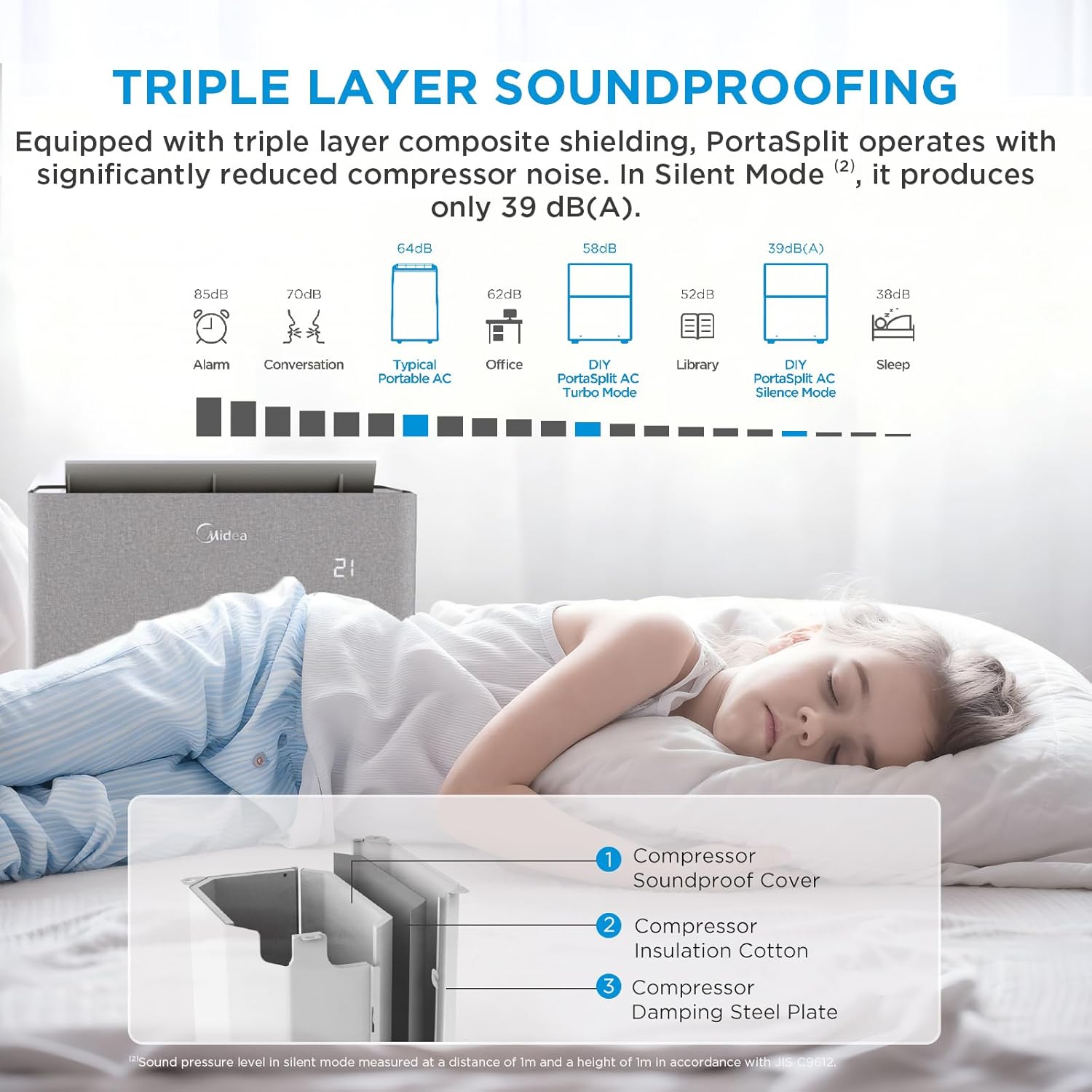
The Midea PortaSplit isn’t technically a window AC — it’s something better. It’s a mobile split system: an indoor unit on wheels plus a compact outdoor unit you place on a balcony, terrace, or mount to a window bracket. No wall drilling, no permanent installation, and none of the compromises of a traditional portable AC.
This product launched in Germany, won the IF Design Award 2025, the German Innovation Award 2025, and was named one of TIME Magazine’s Best Inventions of 2025.
| Spec | Value |
|---|---|
| Cooling | 12,000 BTU / 3.5 kW, covers up to 42 m² / 105 m³ |
| Noise | 39 dB(A) in Silent Mode — quieter than a library |
| Energy | A++ Cooling / A+ Heating, SEER 6.1, Inverter + AI energy optimization |
| Functions | 4-in-1: Cooling, Heating (heat pump), Dehumidification, Ventilation |
| Install | DIY. Mobile indoor unit + window/bracket-mounted outdoor unit. No technician required. |
| Smart | WiFi, Midea SmartHome app, Alexa, Google Home |
| Refrigerant | R-32 (EU compliant, low GWP) |
| Voltage | 220-240V, European plug |
What it does well: It solves the fundamental problem. It delivers split-system cooling power (6× the cooling capacity of traditional portable ACs, per Midea’s testing) with zero permanent installation. The outdoor unit goes on your balcony or mounts to a window bracket — no holes in the wall, no strata approval, no exterior facade modification. The indoor unit rolls between rooms on wheels. At 39 dB, it’s genuinely bedroom-friendly. And the heat pump means you get efficient heating in winter too.
What it doesn’t: It’s not cheap. You need a balcony, terrace, or suitable window for the outdoor unit. The outdoor unit is visible, which may still be an issue in the strictest heritage zones. It’s two separate pieces to manage, not a single all-in-one box.
Who it’s for: Anyone who wants split-system performance without permanent installation. Renters, apartment dwellers with a balcony, people in buildings where external units are banned.
- Midea PortaSplit on Amazon UK
- Midea PortaSplit on Amazon DE
- Midea PortaSplit on Amazon FR
- Search on Amazon IT
Best European Design: Olimpia Splendid Unico Next — No External Unit
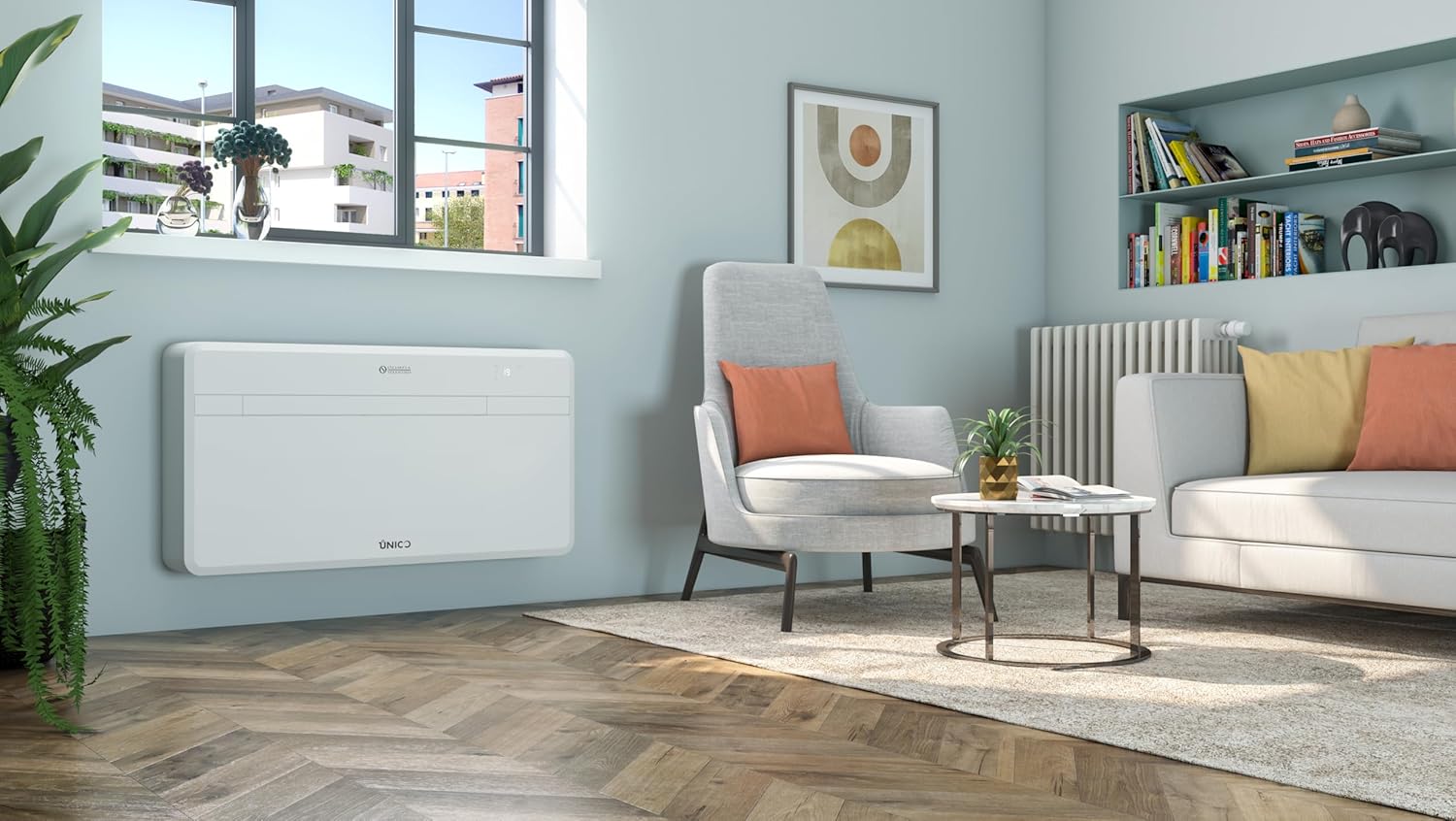
If you want a permanent solution that’s invisible from the outside, Olimpia Splendid — an Italian manufacturer since 1956 — makes something unique. Their Unico Next series is a fixed air conditioner with no external unit at all. Just two small holes in the wall (roughly 10 cm each) for air intake and exhaust. Nothing on the facade.
| Spec | Value |
|---|---|
| Cooling | 3.1 kW (~10,500 BTU), heat pump |
| Noise | 26–30 dB(A) — the quietest option in this guide |
| Energy | Class A (cooling & heating) |
| Functions | Cooling, Heating, Dehumidification, Ventilation |
| Install | Two small wall holes. Typically requires a technician (but no external condenser unit). |
| Smart | Integrated WiFi, Olimpia Splendid Unico app |
| Refrigerant | R-32 (EVAN model), R-290 on newer variants |
| Voltage | 220-240V, Italian/EU plug |
What it does well: It’s the most discreet option. From the street, the building looks exactly the same — no condenser box, no window unit, no visual change at all. At 26 dB, it’s literally quieter than a whisper. Made in Italy with 70 years of engineering behind it. The design is sleek enough that it looks like a piece of furniture, not an appliance.
What it doesn’t: You still need to drill two small holes in the wall — which means landlord/strata approval in some cases, though far easier to get than approval for a full external unit. Approximately €1,500–2,000. Requires professional installation. Only widely available on Amazon IT — limited availability on Amazon UK/DE/FR.
Who it’s for: Homeowners in historic districts, people who want a permanent solution, anyone who prioritizes absolute quiet and invisible exterior.
Olimpia Splendid Unico Next 12 HP EVAN on Amazon IT | Browse Unico Next range
Best Traditional Window AC: Midea EasyCool — 12,000 BTU
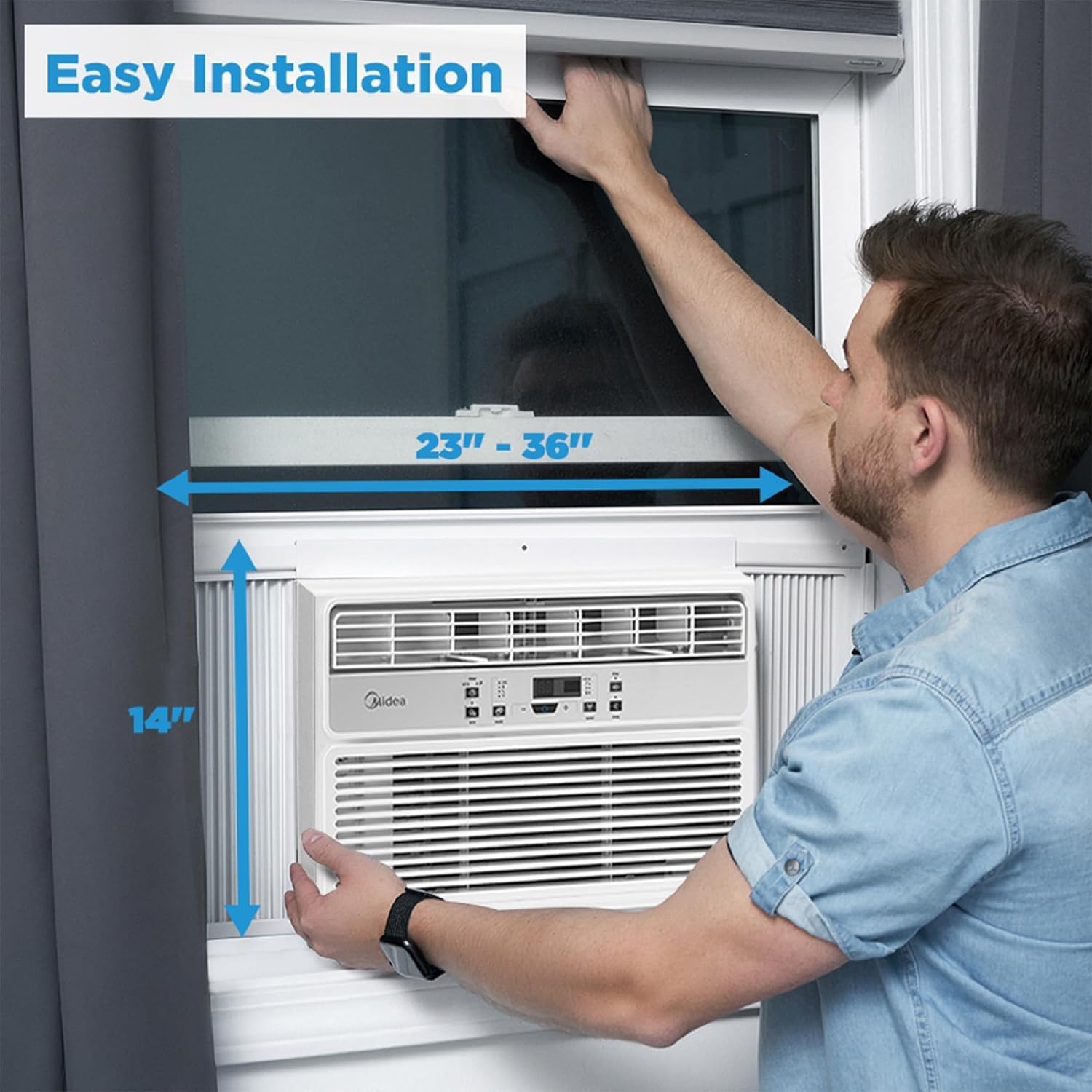
If your home has sliding windows, budget is tighter, and you don’t mind some noise, a traditional window AC is still the simplest option — and Midea’s EasyCool 12,000 BTU is the most established model with a track record on Amazon UK.
| Spec | Value |
|---|---|
| Cooling | 12,000 BTU, covers up to 550 sq ft (51 m²) |
| Noise | Noticeable — reviews consistently mention it’s loud. Best for daytime use or larger rooms where you’re not sleeping next to it. |
| Functions | 3-in-1: Cooling, Dehumidification, Fan |
| Install | Mounts in sliding window frame. Side curtains included. Heavy — 75 lbs (34 kg), two people strongly recommended. |
| Smart | Remote control + LED display. No WiFi. |
| Value | Most affordable per-BTU option. Solid build quality — multiple reviews report units lasting 3+ years of heavy use. |
| Voltage | 220-240V, UK plug |
What it does well: It’s a workhorse. High BTU output at a reasonable price. Midea is a major global manufacturer (they make units for many brands you’ve heard of), so component quality is above the no-name alternatives. If you have a large living room and just need raw cooling power, this delivers.
What it doesn’t: It’s heavy, it’s loud, it’s basic. No inverter technology means higher electricity consumption. No WiFi or smart features. You can’t open the window with it installed.
Who it’s for: People with large rooms and sliding windows who prioritize cooling power and budget over noise and smart features.
Midea EasyCool 12,000 BTU on Amazon UK
Best Portable Alternative: Pro Breeze 4-in-1 — 9,000 BTU

If your windows are casement or tilt-and-turn — which rules out every window-mounted AC — a portable air conditioner with a window seal kit is your best option. Pro Breeze’s 9,000 BTU unit is the most popular choice on Amazon UK for good reason.
| Spec | Value |
|---|---|
| Cooling | 9,000 BTU, covers up to 22 m² |
| Noise | Moderate — quieter than traditional window ACs, louder than split systems |
| Energy | Class A |
| Functions | 4-in-1: Cooling, Dehumidification, Fan, Heating |
| Install | Zero. Roll it into place, attach the window seal kit (included for both sliding AND hinged windows). |
| Smart | WiFi, Alexa, Google Home. 24-hour timer. |
| Awards | Which? Best Buy AC Award |
| Rating | 4.1 / 5 with 793+ reviews on Amazon UK |
| Voltage | 220-240V, UK/EU plug |
What it does well: It’s the easiest possible solution. Unbox it, attach the hose to the window kit, plug it in. Works with any window type. The included seal kit fits hinged windows — which is what most continental European homes have. At ~£200–350, it’s the most affordable entry point. Class A energy rating means it won’t destroy your electricity bill. And it’s available across all European Amazon stores.
What it doesn’t: Portable ACs are inherently less efficient than window or split units because the compressor sits indoors and generates heat that the exhaust hose struggles to expel. A 9,000 BTU portable unit cools more like a 6,000–7,000 BTU window unit in practice. The hose takes up floor space. It’s not as quiet as the PortaSplit or Unico.
Who it’s for: Renters in apartments with casement or tilt-and-turn windows. People who need to move the AC between rooms. Anyone on a budget who just needs a room cool enough to sleep.
Pro Breeze 9,000 BTU on Amazon UK | Search Amazon DE | Search Amazon FR | Search Amazon IT
Amazon Buying Checklist for European Buyers
When buying from Amazon UK, DE, FR, IT, or ES, here’s what to verify before clicking “Buy Now.”
Voltage and Plug
All products recommended in this guide are 220-240V native — they plug directly into European outlets with the correct regional plug. That said, always check the product listing for the voltage spec. Some third-party sellers on Amazon EU list US-import units at inflated prices. If you see “115V” or “120V” on an EU Amazon listing, skip it — you don’t want to deal with a step-down transformer.
EU Energy Label Visibility
If the product page doesn’t show the EU energy label in the product images, that’s a yellow flag. Genuine EU-market units will display it prominently. A missing label may mean the seller is listing a grey-market import. You can ask the seller directly via Amazon messages before ordering.
Warranty and Returns
Window ACs and portable ACs are heavy (20–40 kg shipped). Return shipping costs can be painful. Before ordering:
- Check whether the seller offers free returns or if you’ll pay return shipping
- Verify the warranty period (1–2 years is standard; Midea offers 2 years on PortaSplit)
- Read the 1-star and 2-star reviews specifically for defect rates — a product with 4.3 stars but consistent complaints about units dying after 3 months is a red flag
- If buying from a third-party seller, check their seller rating and account age
Delivery Weight and Access
Amazon will show the shipping weight. A typical unit ships at 25–40 kg. If you live in a walk-up apartment (common in older European buildings), plan accordingly. Some couriers will deliver to your door; others may leave it at the building entrance. Check the delivery details before ordering.
Room Size vs. BTU
| Room Size | Minimum BTU | Recommended Unit |
|---|---|---|
| Up to 15 m² (bedroom/home office) | 5,000–7,000 | Pro Breeze 9,000 BTU (portable) |
| 15–25 m² (master bedroom) | 7,000–9,000 | Pro Breeze 9,000 BTU or window AC |
| 25–35 m² (living room) | 9,000–12,000 | Midea EasyCool 12,000 BTU |
| 35–42 m² (open plan) | 12,000+ | Midea PortaSplit 12,000 BTU |
Note for portable ACs: Subtract roughly 2,000 BTU from the rated capacity to get real-world cooling power. A “9,000 BTU” portable unit cools like a 7,000 BTU window unit because the compressor heat stays indoors.
The Real-World Decision Flow
Here’s how to think about it:
What kind of windows do you have?
- Sliding/hung → any option works, including Midea EasyCool
- Casement / tilt-and-turn → Pro Breeze portable or PortaSplit (outdoor unit on balcony)
Do you have a balcony or terrace?
- Yes → Midea PortaSplit is the best overall solution
- No → window-mounted or portable
Are you renting or do you own?
- Renting → PortaSplit or Pro Breeze (zero permanent changes)
- Owning → any option, Olimpia Splendid Unico if you want a permanent invisible solution
What’s your noise tolerance?
- Want to sleep with it on → PortaSplit (39 dB) or Unico Next (26 dB)
- Daytime use only, don’t mind noise → Midea EasyCool
Budget?
- Under €400 → Pro Breeze 9,000 BTU portable
- €400–800 → Midea EasyCool 12,000 BTU window unit
- €800–1,200 → Midea PortaSplit (varies by country and promotion)
- €1,500+ → Olimpia Splendid Unico Next
A Note on Importing US Models
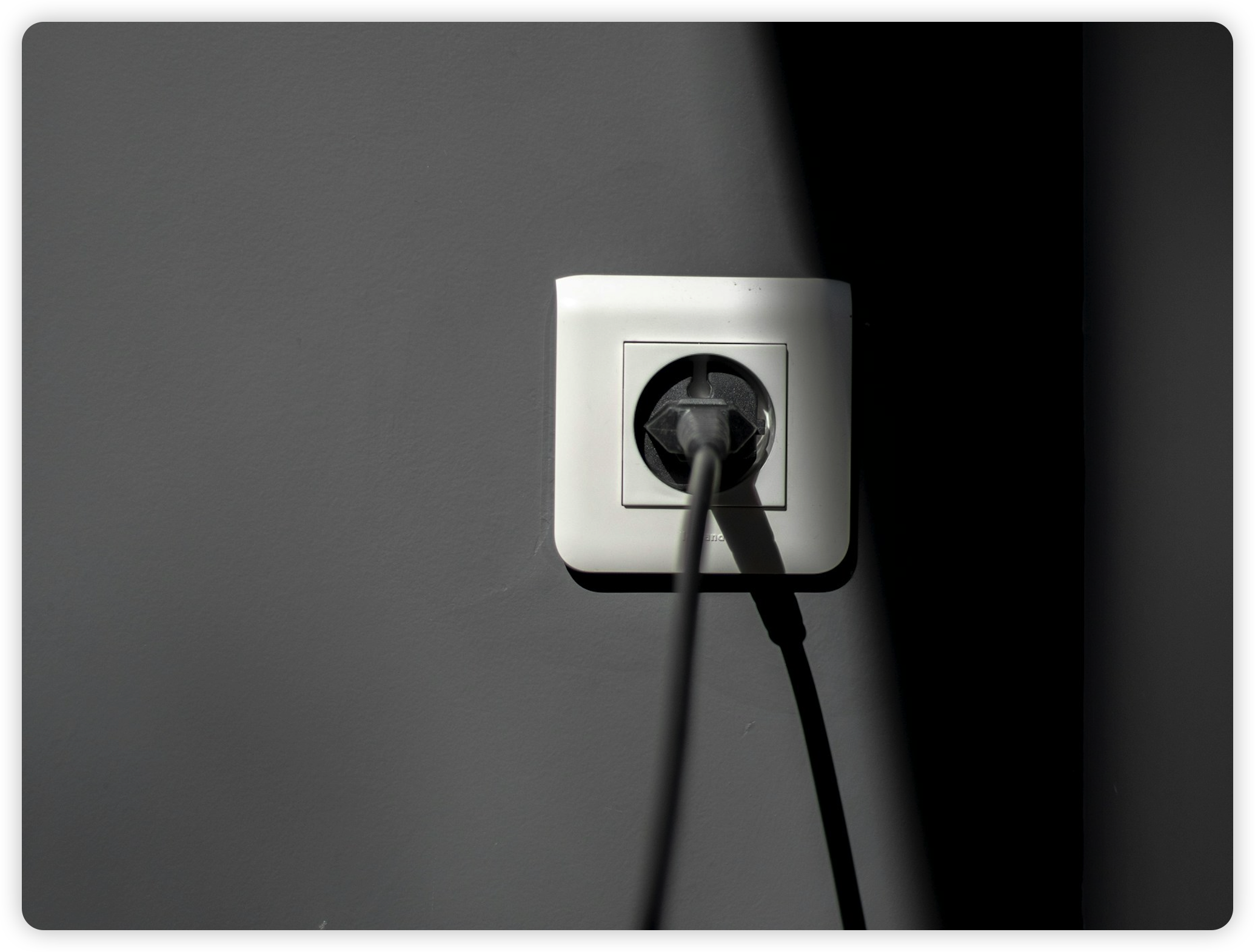
You’ll find many window ACs on Amazon at attractive prices — and then notice they’re actually US-market imports. Models like the Midea U Inverter, TCL Q-Series, and GE Profile are excellent products, but they run on 110–120V / 60Hz. Plugging one into a 220V European outlet will destroy it instantly.
Is it worth importing one with a step-down transformer? In most cases, no. A quality 1,500W transformer costs €60–120, adds bulk, and is another point of failure. By the time you add the transformer cost and international shipping, you’re often close to the price of a native EU-market PortaSplit — which is a better product with a warranty that’s actually valid in Europe.
If you absolutely must buy a US model, you’ll need a step-down transformer rated at least 1.5× the unit’s wattage. And accept that you have no EU warranty.
One More Thing Before You Buy
No single AC unit will cool your entire apartment. It will cool one room — and it will do it well, as long as you match the capacity to the room size and keep the door closed.
Also worth considering: the coming winter. The Midea PortaSplit and Olimpia Splendid Unico both include heat pump functionality — meaning they provide efficient heating in winter as well as cooling in summer. With European gas prices still elevated, a unit that does both can pay for itself faster than you might expect.
TL;DR: If you have a balcony, get the Midea PortaSplit — it’s the most versatile, regulation-friendly solution on the European market right now. If you want a permanent invisible install, look at Olimpia Splendid Unico Next. If you have sliding windows and a tight budget, the Midea EasyCool 12,000 BTU is a solid workhorse. And if you have casement windows and need something today, the Pro Breeze 9,000 BTU portable with window seal kit is your best bet. All available on European Amazon sites with the right voltage and EU compliance. Measure your window first.
Disclosure: This article contains Amazon affiliate links. I have no official partnership with Midea, Olimpia Splendid, Pro Breeze, or any manufacturer mentioned. All recommendations are based on published specifications, independent reviews, and personal evaluation. Prices and availability are as of July 2026 and may change.
